Silver Springs State Park is one of those places Floridians take for granted. The glass-bottom boat tours have been running since the 1870s. Longer than most American national parks have existed. And the springs themselves are legitimately remarkable: one of the largest artesian spring systems in the world, pumping hundreds of millions of gallons of 72-degree water daily from the Floridan Aquifer. But the boats get the marketing. The trails get almost nobody.
I went on a Friday in mid-November, when the humidity had finally broken enough that being outside felt like a choice rather than a punishment. The parking lot near the trailhead was nearly empty. A ranger at the entrance booth gave me a trail map I didn't need and mentioned, without being asked, that the macaques had been active near the river that morning.
The sandhill section
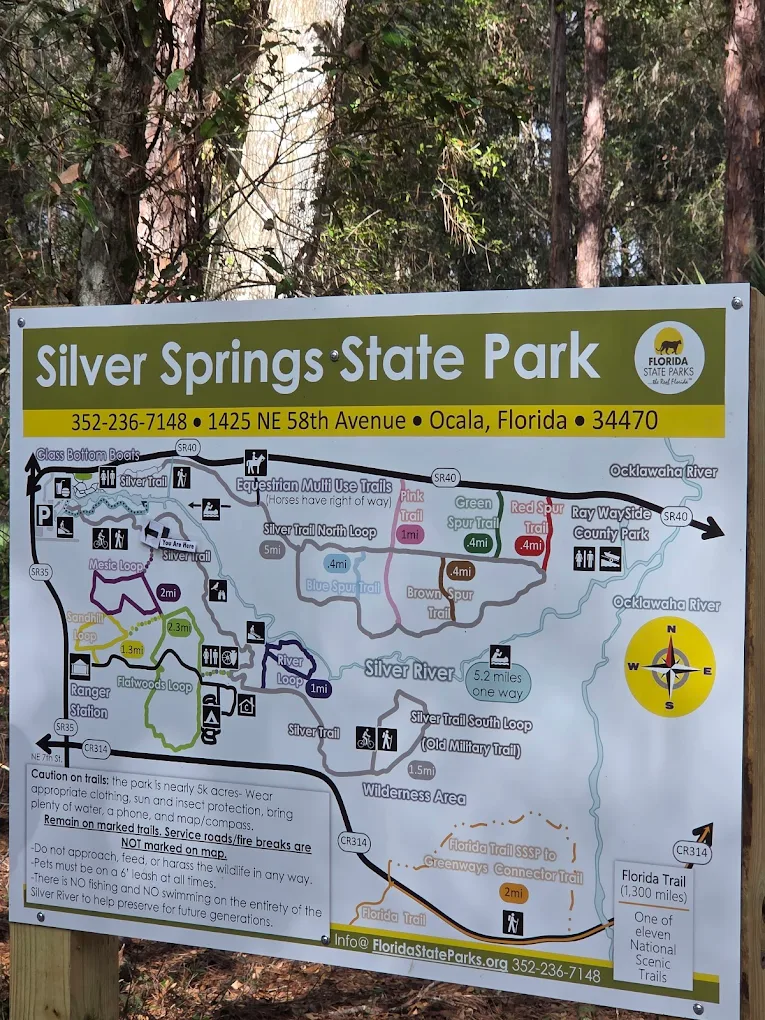
The Sandhill Trail starts in a xeric upland community. Dry, sandy soil, open understory, dominated by longleaf pine and turkey oak. It's not dramatic terrain. The ground is pale and loose, and on a windy November morning the sound of pine needles moving through the canopy is almost musical. A sustained, airy rush that builds and fades without ever quite stopping. Nothing about the pace here asks you to hurry.
Longleaf pine ecosystems are one of the most endangered in North America. They once covered roughly 90 million acres of the southeastern coastal plain. Today, less than three percent of that old-growth longleaf remains. What's left at Silver Springs is not old-growth, but the parkland has been managed with prescribed burns that have allowed the understory to return to something approaching its original character. Wiregrass, runner oak, scattered wildflowers. Walking through it, even in November dormancy, it's possible to sense what the landscape was doing before the turpentine camps arrived.
I saw a fox squirrel near the junction with the Swamp Trail. A large, handsomely marked animal that sat on a mid-height branch and watched me pass with the particular indifference of a creature that hasn't calibrated its fear of humans correctly. They're listed as a species of concern in Florida. Seeing one feels like a small piece of good news.
The transition
The shift from sandhill to swamp forest happens quickly and without ceremony. The elevation drops a few feet. Imperceptible if you're not watching your footing. And the soil goes dark and wet. The oaks and pines give way to red maple, swamp bay, and then, abruptly, bald cypress.
The first cypress you encounter on the Swamp Trail are not particularly large. But as the trail curves toward the river and the ground gets wetter, the trees grow older and wider. Some of them have bases that flare out to five or six feet across, sending knobbed wooden protrusions. Cypress knees. Up through the coffee-colored water around their roots. The textbooks say the function of cypress knees is still debated. They may help with gas exchange in anaerobic soil, or structural anchoring, or both. I find I don't mind not knowing.
A tree that has been standing in this spot since the 1600s does not need me to explain its architecture.
The macaques
I heard them before I saw them. A brief commotion in the canopy, leaves shaking in a pattern that doesn't match the wind. Then a face looking down from about thirty feet up. Rhesus macaques (Macaca mulatta), survivors of a 1930s tourist attraction that released a small population into the wild, apparently believing they couldn't swim and would stay on the island where they'd been placed. They can swim, as it turned out, and they've been reproducing in the Silver River corridor ever since.
They're invasive, and the ecological complications are real. They compete with native wildlife and carry the herpes B virus, which is harmless to macaques but potentially dangerous to humans in the event of a bite or scratch. The Florida Fish and Wildlife Conservation Commission has been managing the population for years, with ongoing debate about methods.
None of which makes seeing them any less startling. A whole social group. Eight or ten animals, a mix of adults and juveniles. Moved through the canopy above me for about three minutes, absolutely unbothered. There's something genuinely disorienting about watching a troupe of primates navigate Florida live oaks. The brain keeps insisting the continent is wrong.
The water
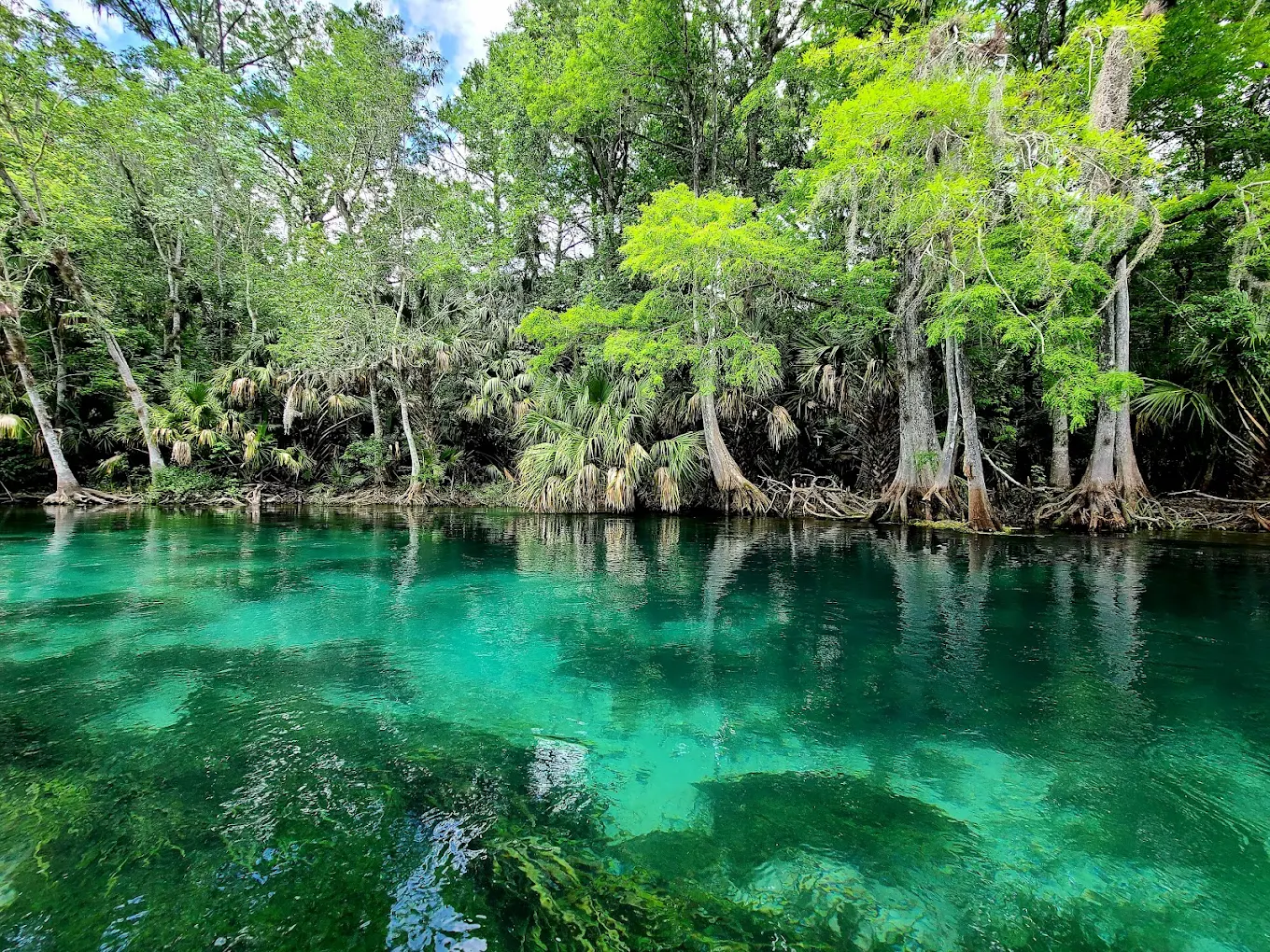
Where the trail comes closest to the Silver River, the water clarity is extraordinary. Even with tannins from the swamp lending it that characteristic tea color in the shallows, the main channel runs clear enough that you can see the bottom through eight or ten feet of water. Mullet move through in loose schools. A great blue heron stands perfectly still on a cypress knee about forty feet out, waiting with the patience of something that has been doing this for fifty million years of lineage.
The springs maintain a constant 72 degrees year-round. In November, that means the water is warmer than the air, and along the riverbank you can see tendrils of mist rising where the temperature differential is sufficient. It gives the whole scene a slightly otherworldly quality. Ancient trees, impossibly clear water, fog rising from nowhere.
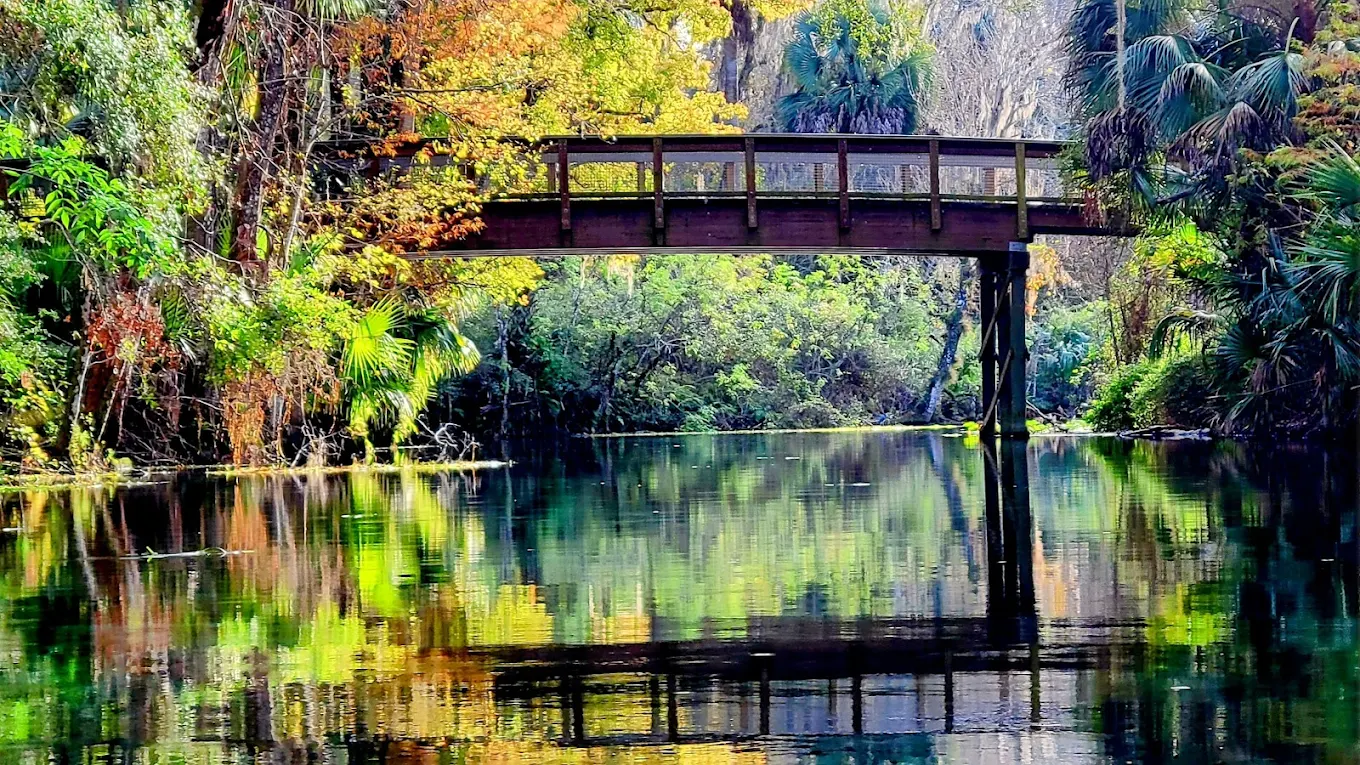
I finished the loop in about two and a half hours, moving slowly. The boat tour queue was backing up by the time I returned to the park entrance. A family with young children was heading toward the glass-bottom boats, and one of the kids pointed at the trail sign and asked where it went. His parents ushered him toward the boats.
The trail goes to the old trees. I didn't say it out loud.