The Marjorie Harris Carr Cross Florida Greenway is one of the more unusual pieces of public land in the state. A 110-mile corridor of conservation land that exists, in part, because of a project that was stopped. The Cross Florida Barge Canal, authorized by Congress in the 1930s and intermittently funded for decades, was finally halted in 1971 after Marjorie Harris Carr and the Florida Defenders of the Environment successfully argued that the canal would cause catastrophic damage to the Oklawaha River ecosystem. The land set aside for the canal eventually became the greenway. What was meant to be a ditch is now a trail system.
The Marshall Swamp Trail is one of the best segments of that system. It runs through the floodplain of the Oklawaha, through a dense canopy that closes overhead to create long tunnels of shade even when the sun is climbing. In early March, with the migratory birds moving through in volume, it's loud in a way that quieter months are not.
The canopy
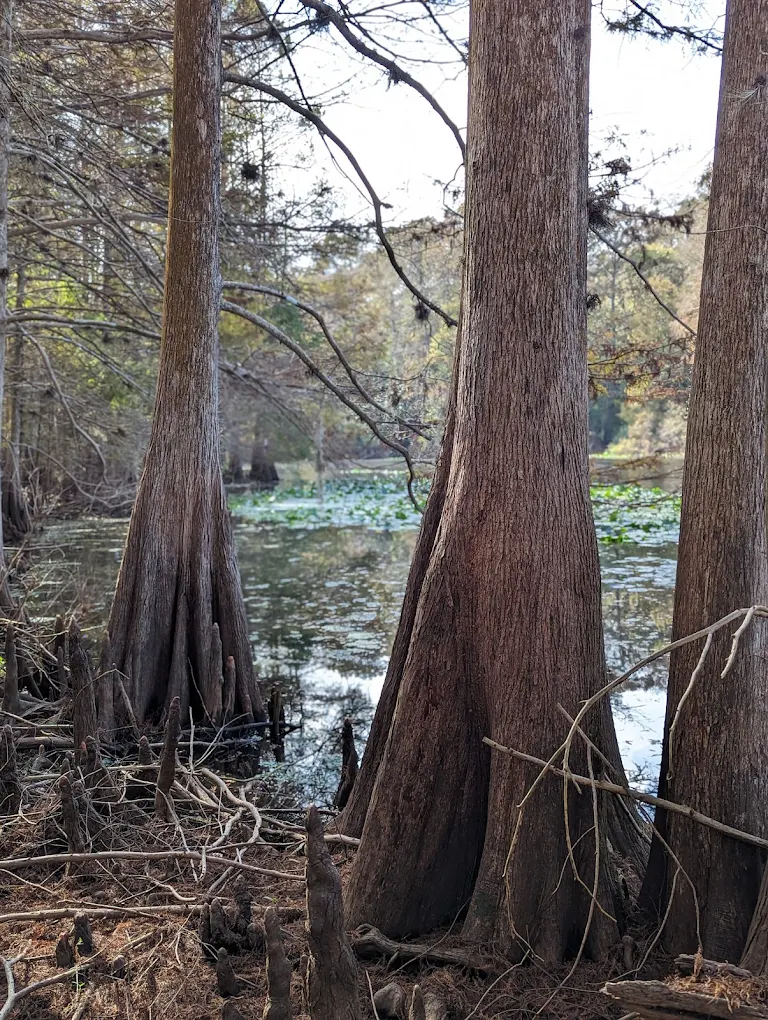
Floodplain forest is layered in a way that upland forest often isn't. There's a mature canopy of red maple, water oak, and swamp laurel oak at the top, then a mid-story of dahoon holly, swamp bay, and Virginia willow, then a dense understory shrub layer, and then the ground layer. Sedges, ferns, and woody debris. That you see through the boardwalk gaps when the trail lifts off the ground.
In early March, the red maples are at their most active. They're one of the first trees to flower in Florida. Small, inconspicuous red flowers appearing before the leaves fully deploy, giving the canopy a reddish haze in late February that most people don't know to look for. By early March the samaras are forming, the winged seed cases that will spin down through still air in a few weeks. The tree is doing a great deal of work while still appearing to be mostly bare.
The palms. Primarily cabbage palm, Florida's state tree. Appear throughout, rising through the canopy at irregular intervals with that particular vertical insistence palms have. They don't branch. They just go up. Against the deciduous canopy, they stand out as a different grammar of growth entirely.
The birds
March is peak migration through north-central Florida. The Oklawaha corridor functions as a travel lane. Birds moving north along the peninsula use the river systems and tree canopy as navigation infrastructure, stopping to feed in the floodplain before continuing. On a good morning in this section of the greenway, it's possible to record thirty or forty species without trying particularly hard.
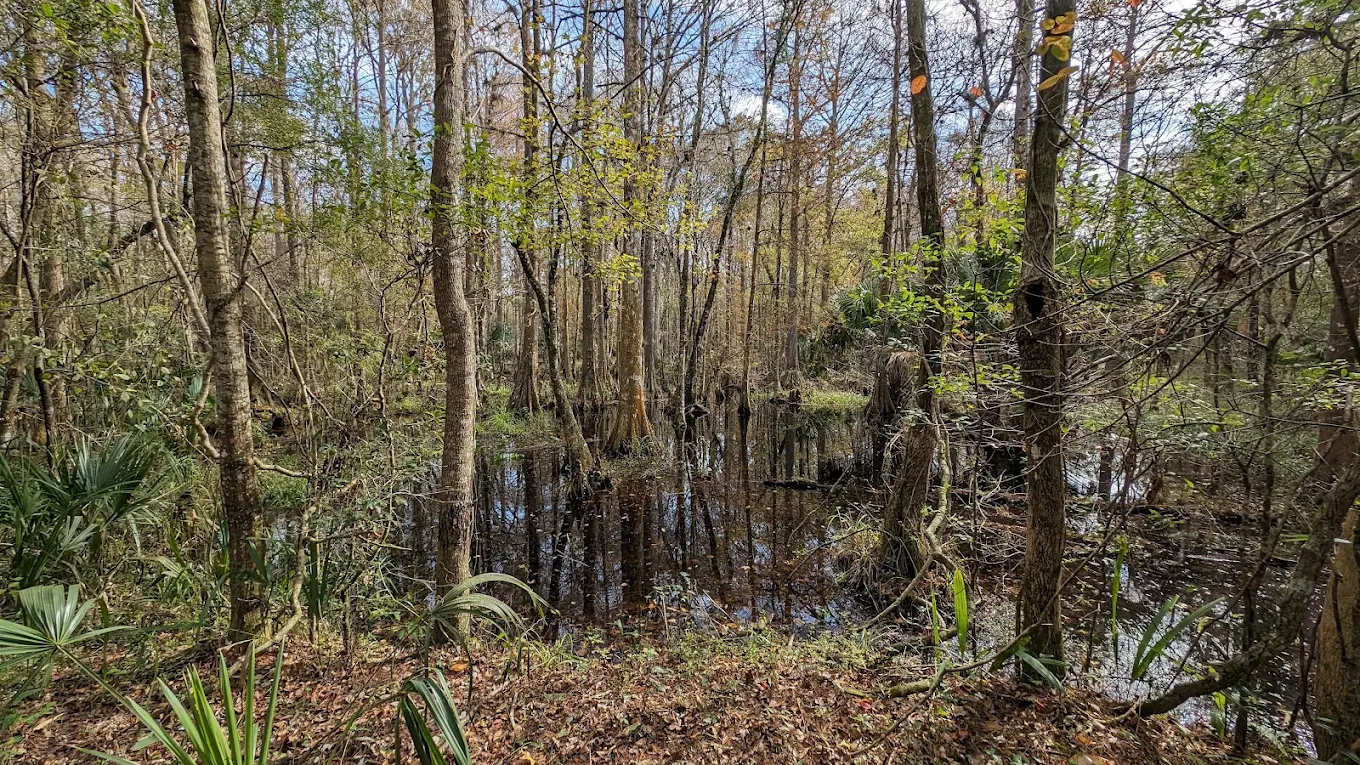
I'm not a birder in any systematic sense, but the volume of sound on this morning made me stop and actually stand still for a few minutes just to listen. There were at least three warblers I couldn't identify by sight. Quick yellow-and-olive shapes moving through the mid-story, too fast and too distant to process before they moved on. A red-shouldered hawk called from somewhere in the canopy, its call the classic sound of Florida swamp, and was answered from what sounded like two different directions. A pileated woodpecker was working on a dead snag about fifty feet off the trail, its excavation loud enough to hear as a distinct rhythmic impact against the ambient birdsong.
A floodplain in spring is not a quiet place. The sound is not pleasant or unpleasant. It's dense, layered, and entirely purposeful.
Wildlife on the ground
White-tailed deer are reliably present in this section of the greenway, frequently browsing the trail edges in the early morning. A doe and what looked like a yearling from last spring were feeding in a small clearing where the canopy had opened. The doe calm and watchful, the yearling still arranged primarily around the novelty of being alive, eating something tentatively, then lifting its head and looking at nothing in particular with great concentration.
Gopher tortoises appear even here in the wetter sections of the trail, though they're more common in the upland dry areas on either side of the floodplain. The trail passes through a transition zone where pine flatwoods border the swamp, and along that edge the tortoise burrows cluster. Round, half-moon entrances in the sandy soil, some clearly active. The burrows are apartment buildings: gopher frogs, indigo snakes, burrowing owls, and over a hundred other species use them as shelter. A single tortoise can maintain multiple burrows. They're considered a keystone species not for what they eat but for what they dig.
The boardwalk
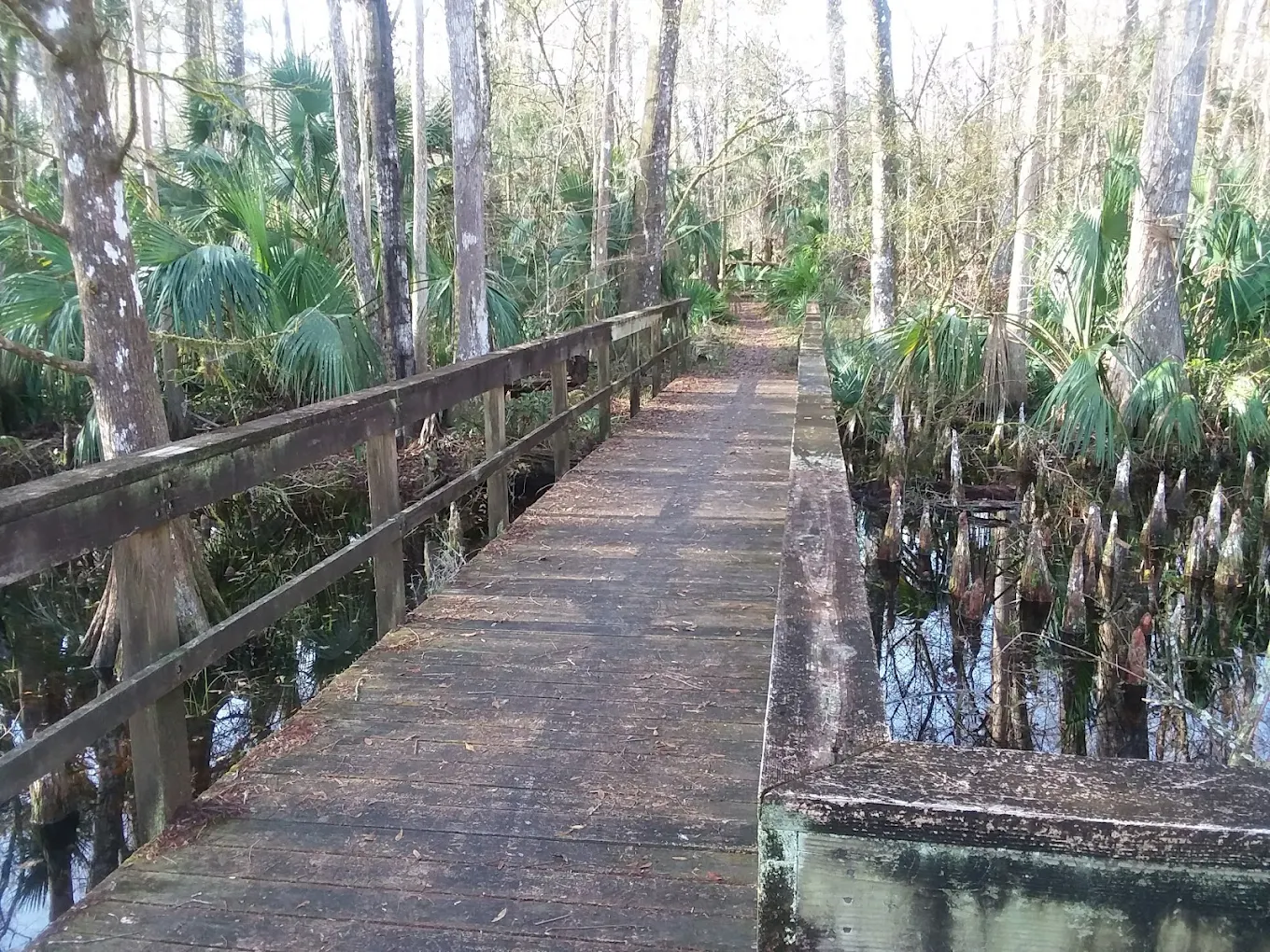
The most distinctive section of the Marshall Swamp Trail is the wooden boardwalk that crosses the wetter, lower portions of the floodplain. Raised above the surface, letting you walk through the swamp interior without the mud. From the boardwalk, the swamp floor is visible below: dark water standing in irregular pools among the root systems, covered in duckweed that shifts in any air movement, the whole surface a matte green broken by the narrow trunks of young maples and willows growing up from the water.
The ferns are extraordinary in early March. Cinnamon fern, royal fern, and netted chain fern are already at full deployment, growing in dense masses along the boardwalk margins and out into the shaded swamp floor. In Florida's climate they never entirely die back, but in spring they're at maximum density, pushing up from the leaf litter with an urgency that makes the swamp floor look actively alive in a way that's easy to underestimate.
The smell from the boardwalk is damp earth and something sweet and faintly fermented. It's the decomposition of last year's organic matter going forward, releasing carbon and nitrogen into the system. Floodplain forests are among the most productive ecosystems for this kind of nutrient cycling. The mud doesn't smell like decay. It smells like productivity.
The trail is about four miles out and back from the main access point, though it connects to a longer network that extends in both directions along the greenway. I turned around at the far end of the main boardwalk section and retraced my steps, which in dense forest usually feels redundant but here didn't. The birds had shifted, a river otter was working the edge of a pool that had been empty on the way out, and the light had changed enough to make the fern floor look entirely different.
You can do the Marshall Swamp Trail any time of year. But early March, when the birds are moving and the ferns are at peak growth and the sun is still low enough to come in at an angle through the canopy gaps. That's when it's doing its best work.